Oscar Health (OSCR)·Q4 2025 Earnings Summary
Oscar Health Guides to Profitability as Membership Surges 58%, Stock Jumps 5%
February 10, 2026 · by Fintool AI Agent
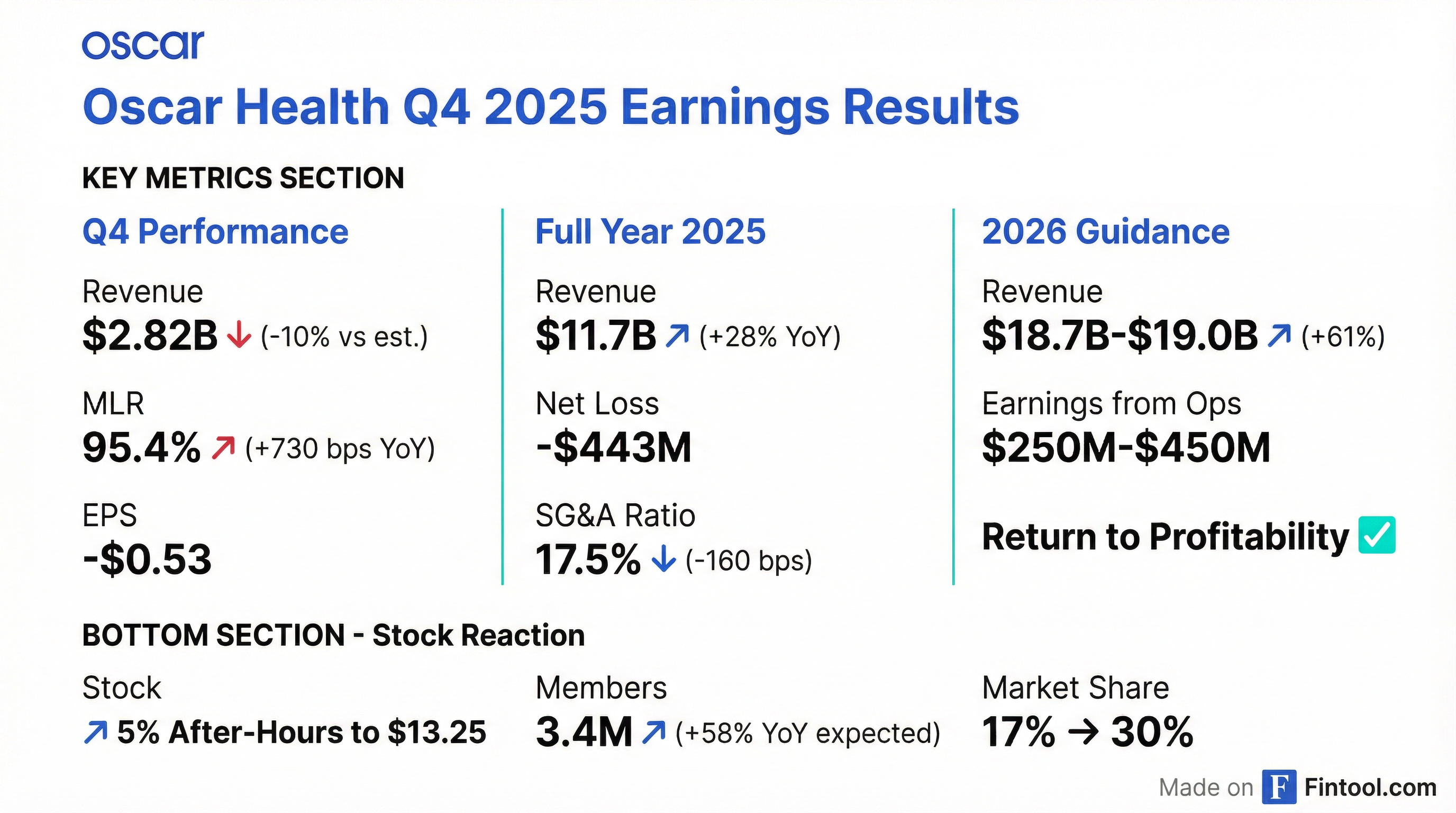
Oscar Health delivered a mixed Q4 2025 with revenue missing estimates by 10%, but the market cheered the company's bold 2026 outlook calling for a return to profitability. Shares rose ~5% after hours to $13.25 as management guided for $250-450 million in earnings from operations—a $750 million swing from 2025's $396 million operating loss.
The ACA-focused insurer achieved record membership of 3.4 million, positioning itself to capture 30% market share as competitors retreated following the expiration of enhanced premium tax credits.
Did Oscar Health Beat Earnings?
Q4 2025 missed on revenue but beat on EPS (smaller loss than expected):
The revenue miss was driven by a $275 million risk adjustment true-up in Q4, as Oscar's membership skewed healthier than the broader market. MLR spiked to 95.4% due to industry-wide morbidity increases from Medicaid redeterminations.
Full Year 2025 Results:
 Ask Fintool AI Agent
What Did Management Guide for 2026?
Oscar provided aggressive 2026 guidance signaling a dramatic turnaround:
CEO Mark Bertolini emphasized the return to profitability: "Oscar is on track to return to profitability this year. We expect a significant year-over-year improvement of nearly $750 million in earnings from operations in 2026."
The guidance assumes risk adjustment as a percentage of direct premiums of approximately 20% and market contraction toward the lower end of Oscar's original 20-30% projection.
How Did the Stock React?
OSCR closed at $12.66 during regular trading (+3.4%) and jumped to $13.25 in after-hours trading (+5% from prior close). The positive reaction reflects:
- Profitability pivot: 2026 guidance for $250-450M operating income vs -$396M in 2025
- Membership momentum: 58% YoY growth expected, market share doubled to 30%
- Operational leverage: AI driving 160 bps SG&A improvement with higher membership
The stock is trading at $12.66 vs. analyst consensus price target of $14.82 (17% upside), with UBS and Barclays recently setting targets of $17-$18.
What Changed From Last Quarter?
The narrative shifted from loss management to growth acceleration:
The metal mix transformed dramatically following enhanced premium tax credit expiration:
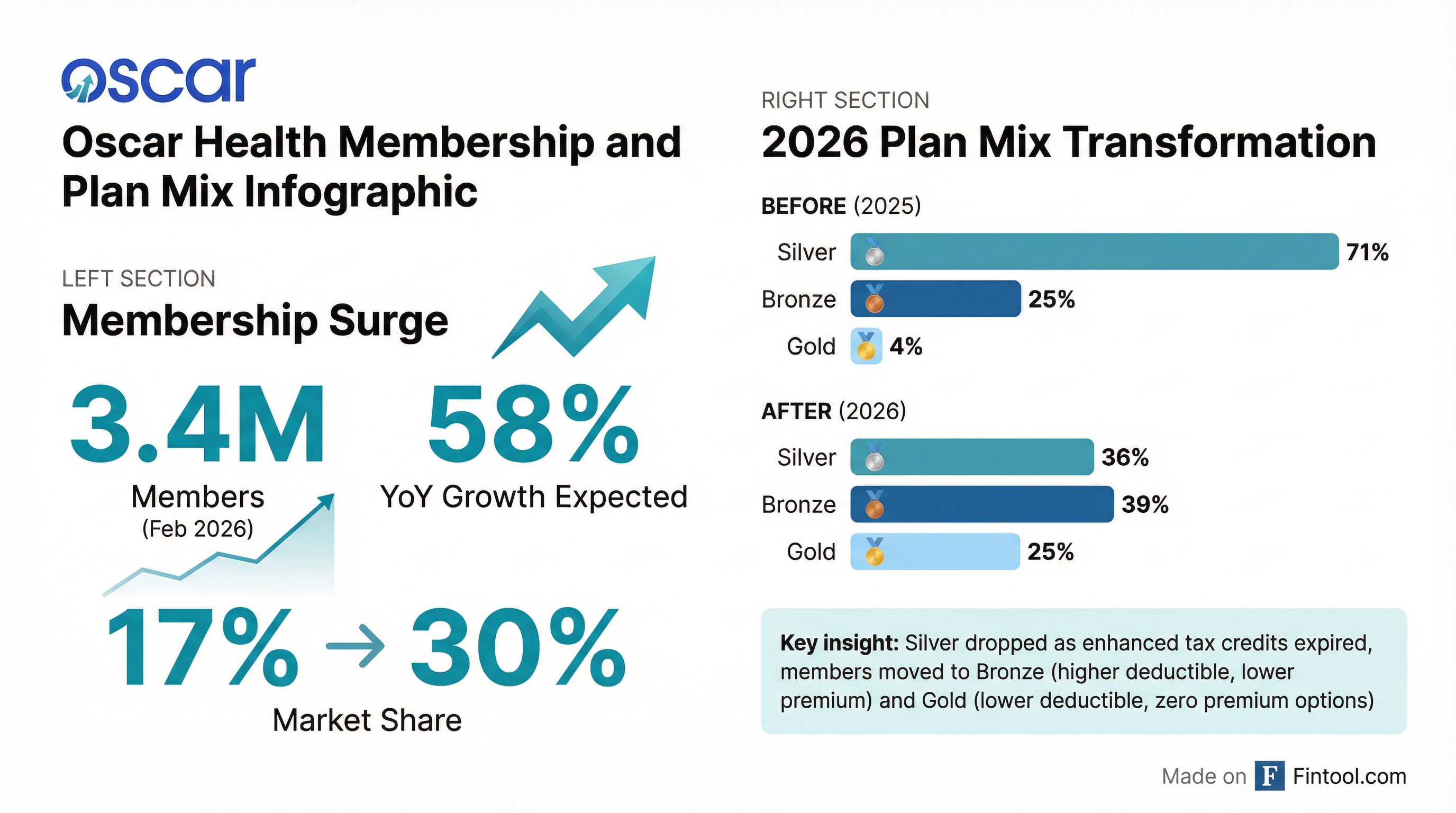
CFO Scott Blackley noted: "Bronze has always been a high-performing product for us. The fact that we've seen more growth in Bronze than in Silver, and we've seen that transition, is actually something that we are completely comfortable with."
Ask Fintool AI AgentKey Management Commentary
On market positioning (CEO Mark Bertolini):
"Oscar embraced the change and positioned the company for strong top-line growth and margin expansions in 2026. We took decisive actions with a disciplined pricing, distribution, and product strategy to go after profitable growth as competitors pulled back or exited the market."
On member churn expectations (CFO Scott Blackley):
"Through the first quarter, we're obviously going to see higher churn as we see the effects of the higher premiums... From there, we're expecting churn patterns to look more similar to what we saw pre-ARPA, so in the range of 1%-2% a month."
On AI investments (CEO):
"The impact of AI on our efficiency and the quality of the interactions for our members is unparalleled in its pace in my 40 years in this industry."
Q&A Highlights
On new member visibility (Josh Raskin, Nephron Research): Management explained they're using third-party clinical data to assess new member risk profiles, which is giving them "better insights into this oncoming membership than we've had really at any point in our history." New initiations are tracking "modestly better" than pricing and expectations.
On passive enrollment risk (John Ransom, Raymond James): Bertolini acknowledged uncertainty: "When they start looking at the out-of-pocket costs associated with plans... they're going to start to say, 'Wait a minute. This is expensive.' Most Americans now see healthcare as their single largest line item in their homes, more than their own mortgage."
On ICHRA opportunity: Oscar is building a two-pronged ICHRA strategy—conversion services for employers (higher margin, unregulated) plus membership capture in their health plan. ICHRA membership doubled year-over-year.
Risks and Concerns
-
Passive enrollment churn: 400K members expected to roll off by Q2 as members face premium shock from lost subsidies
-
Risk adjustment volatility: Oscar noted they're "picking up a very large share of young, healthy members" which increases risk transfer payments
-
Utilization uncertainty: With members moving to higher-deductible Bronze plans, out-of-pocket costs could drive either care avoidance or further disenrollment
-
Political risk: Enhanced premium tax credits remain a political issue; any reinstatement would reshape market dynamics
Capital Position
Oscar strengthened its balance sheet with a new $475 million three-year revolving credit facility from JPMorgan Chase. Key metrics:
Forward Catalysts
Ask Fintool AI AgentThe Bottom Line
Oscar Health delivered a challenging Q4 with a 10% revenue miss driven by risk adjustment headwinds, but the 2026 guidance stole the show. The company is guiding for 61% revenue growth and a $750 million swing to profitability—a bold call that hinges on member retention, disciplined pricing, and continued AI-driven efficiency gains.
The market's +5% after-hours reaction suggests investors are buying the turnaround story. With membership at record levels and market share doubling, Oscar has positioned itself to be a major winner in the post-enhanced-subsidy ACA landscape. The key risk remains execution: can they convert 3.4 million enrolled members into 3 million paying customers while maintaining margin discipline?
Related: Oscar Health Company Profile | Q4 2025 Earnings Transcript | Q3 2025 Earnings